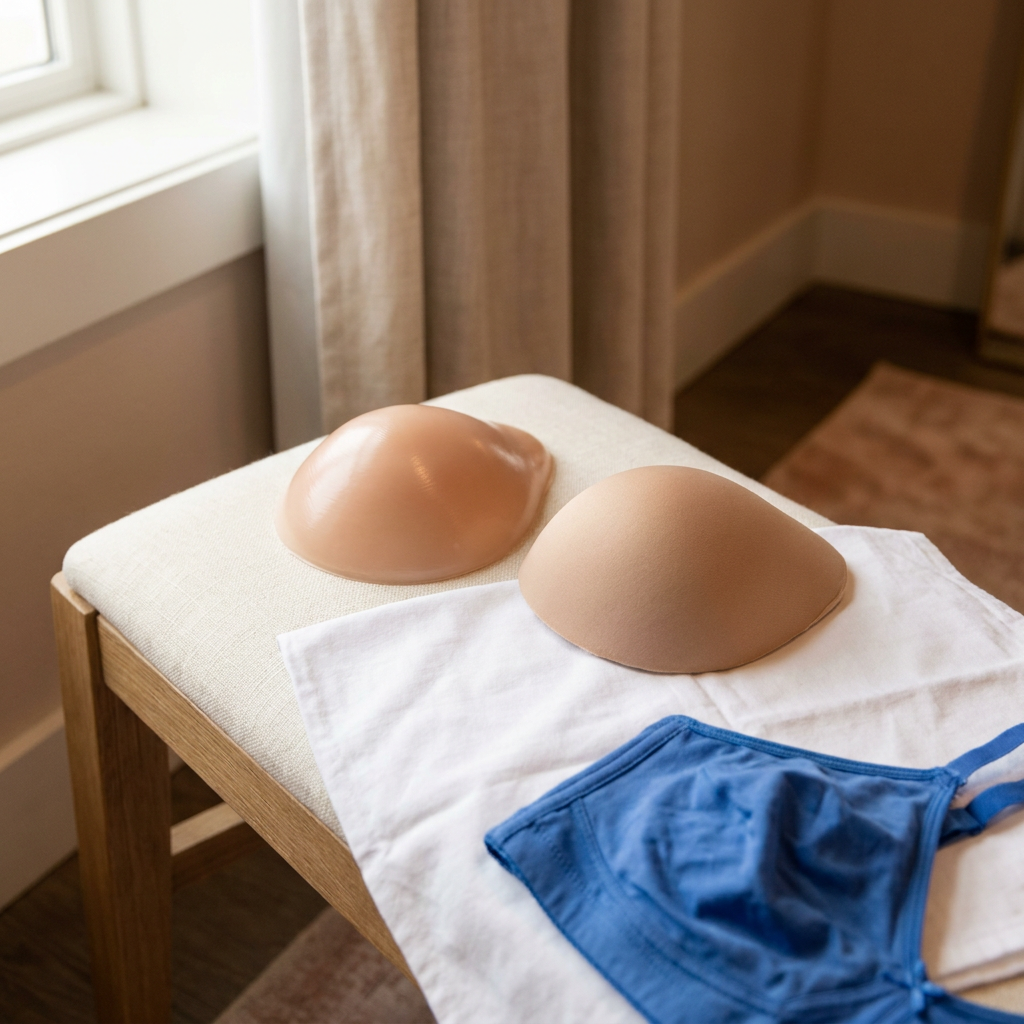
Most women who wear a breast form end up owning more than one. The first is chosen by where you are in healing, not by which material you prefer, and a second gets added later for the days the first is wrong for: a workout, a July afternoon, a long flight.
Silicone, lightweight silicone, foam, and a custom form each solve a different problem. Weight, heat, cost, and how often insurance renews one decide it.
Your First Form Is Chosen by Your Healing, Not Your Preference
You will likely go home with a temporary form: a soft fiberfill “softie” that weighs almost nothing. A full-weight silicone form presses on a site that is still healing, so it is too heavy for the early weeks. What fits changes as drains come out and swelling settles, along a fairly predictable week-by-week progression.
Fitting for a permanent form generally happens six to eight weeks after surgery, once the surgical site has healed. Recovery varies, and your surgeon or care team gives the clearance.
Radiation extends that window. Skin needs to recover from radiation before silicone is comfortable against it, and radiated skin under a bra band brings problems of its own. Adhesive and contact forms, which stick to the chest wall, need fully healed skin, so they are not an early option.
Key takeaway: The first six to eight weeks call for a lightweight form; your care team clears you for weight.
Silicone Feels Most Like a Breast; Foam Feels Better in August
Once you are cleared for weight, there are four options. Silicone moves the way breast tissue moves. Foam and fiberfill are barely there.
| Type | Feel and weight | Heat and activity | Insurance typically allows a new one every | Best for |
|---|---|---|---|---|
| Standard silicone | Closest to breast tissue; natural weight | Warmer against the skin | 2 years | Everyday wear; symmetry after single mastectomy |
| Lightweight silicone | Silicone feel, less weight | Cooler than standard | 2 years | Long days, larger cups, shoulder or neck strain |
| Foam, fiberfill or bead (leisure) | Very light, less natural movement | Coolest; swims and dries fast | 6 months | Healing, exercise, hot weather, sleep, travel |
| Custom | Made to your chest wall, so it sits like a puzzle piece | As silicone | Ask your plan | An uneven chest wall, or when nothing off the shelf sits right |
A standard silicone form is $430 and a custom form is $4,600, before insurance and current as of 2026. Ask us about the other styles.
Key takeaway: Silicone buys weight and movement, foam buys coolness. Insurance usually renews silicone every two years, non-silicone every six months.
Most Women End Up Owning More Than One
Silicone for work and for anything with a fitted neckline. Lightweight or foam for the gym, the pool, hot weather, sleep, and travel.
That is not indecision. A weighted form holds its shape under a swimsuit but warms up on a ninety-degree afternoon; a foam form dries in minutes and never feels heavy. If exercise is part of your week, settle whether your sports bra can hold a form first.
Key takeaway: One form for weight and shape, one for heat and movement.
Replacing a Form Starts With a Prescription
Medicare Part B and most commercial plans include coverage for breast forms and mastectomy bras when your doctor writes a prescription. Most plans allow a new silicone form about every two years, and a new non-silicone form — foam, fiberfill, or bead — about every six months. How much of the cost is covered depends on your plan, and a fitter who bills insurance daily can check yours before you order.
Front Room Underfashions is an ABC accredited facility, and our fitters are accredited by both ABCOP and BOC.
Key takeaway: A prescription is what opens coverage, and most plans renew silicone every two years against non-silicone every six months.
A Form Only Works If the Pocket Holds It
A form that slides during the day is usually a bra problem. The pocket has to sit where the form sits, and the band has to be snug. Most mastectomy bras have pockets sewn in and many regular bras can have one added; in the earliest weeks the softie rides in a post-surgical camisole or compression bra.
After a single mastectomy, matching the weight of the other side is a posture question, not only an appearance one. A form that is too light leaves your shoulders and back pulling unevenly, which shows up as neck and shoulder ache by evening. After a lumpectomy, a partial form fills one section rather than the whole breast.
Front Room Underfashions has sewing machines on site, so a pocket can be added to a bra you already own.
Key takeaway: Even weight protects your back and shoulders; the pocket is what holds it there.
It Is Normal to Change Your Mind
Women change forms. The one that felt right at eight weeks can feel heavy a year later, or too light after a weight change, or wrong for a summer nobody planned for. Owning two is not a failure to decide. It is just what wearing one teaches you.
Come Try a Few On
Three forms in a fitting room settle what no chart can. An accredited fitter weighs the options against your bra, your shoulders, and where you are in healing. Schedule a custom fitting at the Lincoln Court boutique or at either cancer center location. The fitting is complimentary.